
The “Aha” Moment
Lately, the trend in specialty coffee has been moving toward incredibly delicate, high-clarity cups—washed Geshas with tea-like bodies that mimic White Teas like Jasmine. A personal favorite of mine is a bright, washed Ethiopia Yirgacheffe that drinks like a sophisticated First-Flush Darjeeling.
But lately, I’ve been chasing those same sophisticated notes—florals, high-clarity sweetness, and a lingering finish—directly at the source: Specialty Japanese Tea.
It started with a simple curiosity. I picked up a bottle of Jasmine tea at a local Japanese convenience store. It was that familiar, nostalgic flavor, but like commodity coffee, it was one-dimensional. It lacked the “pop” and complexity of a specialty product. Living in Japan, I realized I was sitting on a goldmine. While authentic Chinese imports can be rare here, the world-class tea houses of Kyoto were right under my nose.
The Green Tea Spectrum: Beyond Matcha
Most people outside Japan are familiar with Matcha (powdered green tea), but that’s just one expression of the leaf. In the world of loose-leaf tea, there is a hierarchy of intensity:
- Sencha: The standard, sun-grown everyday tea.
- Kabusecha: “Shaded” tea. The plants are covered for about a week before harvest to boost sweetness.
- Gyokuro: The “espresso” of the tea world. Shaded for 20+ days, it is incredibly concentrated, savory (umami), and expensive.
My Adapted Sake Gear Setup
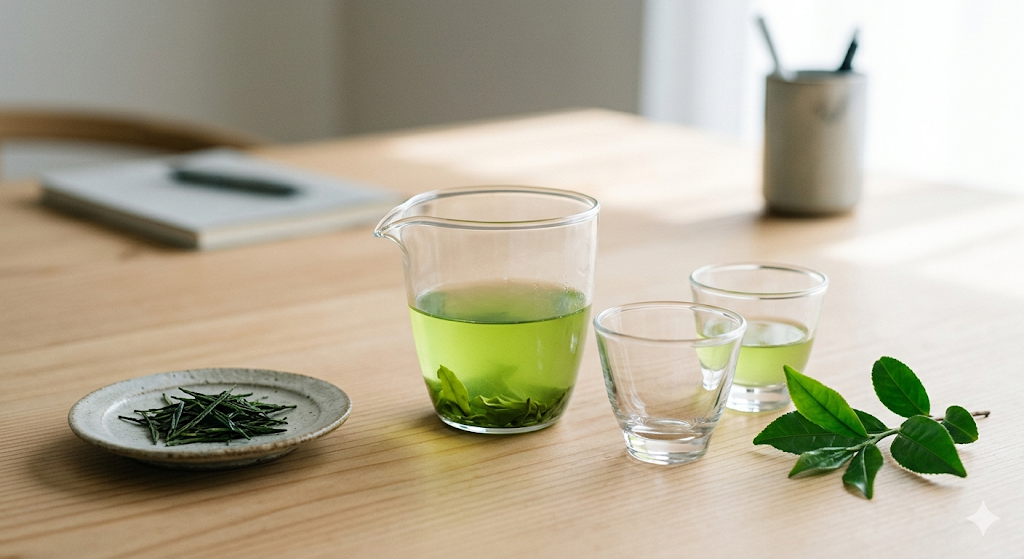
High-grade shaded teas like Kabusecha and Gyokuro demand precision. They are typically brewed at low temperatures—around 50–60°C—to extract umami while keeping bitterness at bay.
In the tea world, there is a specific handle-less teapot called a Hohin (literally “treasure vessel”). The logic is simple: if the vessel is too hot to pick up, the water is too hot for the leaves. Rather than buying new gear, I realized my glass Katakuchi (a traditional sake pitcher) and matching 40ml sake glasses were the perfect functional equivalents. The Katakuchi offers the same tactile feedback as a Hohin, and the small glasses are ideal for the high-concentration, “shot-style” pours these teas require.
The “Calm-Alert” State
One of the most interesting aspects of high-end green tea is the L-Theanine content. It chemically modulates the caffeine, smoothing out the “spike” you might get from an espresso. The result is a focused, meditative state—perfect for a long afternoon of photo editing or deep work.
Lately, the trend in specialty coffee has been moving toward incredibly delicate, high-clarity cups, washed Geshas with tea-like bodies that mimic White Teas like Jasmine. A personal favorite of mine is a bright, washed Ethiopia Yirgacheffe that drinks like a sophisticated First-Flush Darjeeling. Lately, I’ve been chasing those same sophisticated notes, florals, high-clarity sweetness, and a lingering finish at the source: Specialty Japanese Tea.